
Round 3 is open. Subsidized electric vans and shuttles for NYC fleet operators.
RFA-CTAP-2026-03 makes 91 battery-electric passenger vehicles available to New York City transportation providers serving disadvantaged communities — leased through the program, no down payment, with charging and parking available if you want them. Apply online, or download the RFA and fill in the application on your computer.
Round 2 (RFA-CTAP-2026-02) closed October 23, 2026. Round 1 (RFA-CTAP-2026-01) closed August 31, 2026.
Rounds 1 and 2 · RFA-CTAP-2026-01 and -02
Both rounds have closed. If you applied to either, you’re on file and don’t need to start over — see “I applied to Round 1 or Round 2” in the FAQ. If you missed them, Round 3 is the round to apply to now.
Round 3 · RFA-CTAP-2026-03
91 battery-electric passenger vehicles, subject to funding availability. Two ways to apply, both treated the same: online on this page, or the fillable PDF emailed to RFA@dollaride.com.
Two ways to apply. Same questions, same review.
Both routes collect the three RFA forms — Form A (company profile), Form B (vehicle request and replacement schedule) and Form C (operations checklist). No attachments at application. Pick whichever suits how you work.
Apply online
- Work through six short steps on this page. You can close the tab and come back on the same device — your answers are kept.
- Review the questions you left blank. If one doesn’t apply to your operation, write “N/A”.
- Submit. Your submission time is recorded, and you can download a copy of your answers.
Download, fill in, email
- Download the PDF and open it in Adobe Acrobat Reader (free), Preview on a Mac, or Chrome or Edge.
- Click into the boxes to type and tick the checkboxes — no printing, no scanning, no signature software. Save the file.
- Email it to RFA@dollaride.com with “RFA-CTAP-2026-03 — [Company Name]” in the subject line.
Deadline for both: Friday, November 13, 2026, 5:00 PM Eastern.
A vehicle, and the infrastructure around it
CTAP is not a cash grant. CTAP LLC, administered by Dollaride, purchases the vehicles, holds title, and leases them to awardees — with the NYSERDA incentive applied in the lease rate. (RFA Sections 1.2–1.3)
Battery-electric vehicle lease
A vehicle selected from the program’s electric vehicle options for shuttle operators — vans through Class 5 shuttle buses. See the vehicles.
Telematics
Facilitates route and operations optimization.
NYSERDA compliance administration
Dollaride handles program reporting on the awardee’s behalf.
Charging access
The CTAP charging network in the Bronx, Brooklyn, and Queens on preferential terms, your own charging, or potential CTAP installation dedicated to you.
Parking
Your existing site, lawful street or home parking, or potential CTAP program parking dedicated to you.
Ownership pathway
Operating lease, lease-to-own, or financing through your own dealer or lender. Compare the tracks.
What the numbers look like
The RFA’s own comparison, per vehicle per month, for a new vehicle. The CTAP lease requires no down payment. (RFA Section 2.1)
The monthly payment
| Monthly cost component | Comparable new gas unit (private lease) | New CTAP electric unit, as low as (CTAP lease) | Savings |
|---|---|---|---|
| Financed or leased payment | $1,600 | $1,100 | $500 |
Fuel and parking, if you opt in
| Monthly cost component | NYC market | CTAP | Savings |
|---|---|---|---|
| Fuel / electricity (opt-in) | $1,000 gas | $500 EV charging | $500 |
| Parking (opt-in) | $600 | $500 | $100 |
| Total monthly | $1,600 | $1,000 | $600 |
All figures are the RFA’s estimates for comparison purposes only. Actual costs vary by vehicle configuration, vehicle type, lease mileage, battery capacity, and the charging solution used. Charging and parking are optional.
Three tracks. Your pick on Form B.
Operating lease
CTAP LLC purchases the vehicle and holds title. You lease for the term; the vehicle returns at the end.
Lease-to-own
As Track A, plus a fixed-price purchase option exercisable at the end of the base lease term — not before the end of the NYSERDA Agreement term.
Capital partnership
Your own lender or dealer provides the debt, lent to CTAP LLC, which purchases and titles the vehicle. The incentive attaches, and you lease under Track A or B.
Not sure which fits? “Undecided, want to discuss” is a real option on Form B. (RFA Sections 2.4–2.5)
Eligibility, in three tiers
The first tier is set by NYSERDA and can’t be waived. The second comes from the program’s lenders. The third is operational — where Dollaride has the most room to help you get to yes. (RFA Section 4)
Program eligibility — NYSERDA-mandated
- Your company holds operating authority in its own name — NYSDOT authority, a NYC TLC base or operating license, or other applicable authority. The authority you hold also shapes which vehicle fits: the Ford E-Transit is not currently on the TLC’s approved accessible vehicle list, so it can’t yet be put into service under a TLC for-hire base license alone. NYSDOT authority and TLC commuter van authorization are the working paths today; a TLC paratransit base can run the wheelchair-accessible E-Transit.
- You operate a regular passenger transportation service.
- You serve disadvantaged communities in New York City.
- You’re requesting battery-electric vehicles only. Plug-in hybrids and conventional hybrids are not eligible.
- The vehicle’s acquisition cost falls between $52,501 and $232,500.
Eligible passes all three tiers and moves to scoring. Deferred a curable gap — Dollaride states what needs to change and re-screens on request, without a new application. Denied fails a non-waivable NYSERDA requirement; Dollaride states which, and where possible points to alternative programs.
The Round 3 timeline
Straight from the RFA cover page. Vehicles are ordered, delivered, registered and deployed six to nine months from MSA execution.
| Date | Milestone | Notes |
|---|---|---|
| Aug 11–31, 2026 | Round 1 (RFA-CTAP-2026-01) | Closed |
| Oct 1–23, 2026 | Round 2 (RFA-CTAP-2026-02) | Closed |
| Wed, Oct 28, 2026 | RFA Round 3 issued | |
| Wed, Nov 4, 2026 | Written questions due | 5:00 PM ET, to the designated contact |
| Fri, Nov 6, 2026 | Consolidated Q&A published | Issued to all registered applicants |
| Fri, Nov 13, 2026 | Application deadline — Round 3 | 5:00 PM ET |
| Fri, Nov 20, 2026 | Eligibility screen complete; all applicants notified. Conditional Allocation Letters; vehicle allocation made; Fleet Operator Letters of Intent (LOI) issued | Within a few business days of close |
| Wed, Nov 25, 2026 | Fleet Operator Letters of Intent executed | Each letter states its own expiration date |
| Within 14 days of NYSERDA’s Go decision target as early as Mon, Dec 7, 2026 | Documentation due diligence, Participation Agreement, and Master Services Agreement (MSA) execution deadline — allocation expires | Unexecuted allocations return to the pool; the applicant moves to the waitlist |
How applications are reviewed
Stage 1 is a pass/fail eligibility screen — every applicant is told the outcome and the reason. Stage 2 scores eligible applications on the published rubric below, and vehicles are allocated in score order until Round 3 is fully subscribed. Ties go to the earlier submission. Qualified applicants not reached, and qualified applications received after the deadline, go on a waitlist in order of submission date. (RFA cover page, Section 6)
Examples of electric vehicles for shuttle operators
The table shows Ford E-Transit 350 configurations currently available through the program. Other passenger EV models are also eligible for CTAP funding — examples below. Tell us on Form B what you need. Range is up to 126 miles per charge on the 68 kWh E-Transit; the wheelchair lift uses about 1% of the battery over a typical shift. (RFA Section 7)
| Ford E-Transit 350 | Specifications | Features | Passengers | Wheelchair accessible (WAV) |
|---|---|---|---|---|
| Medium Roof (4+2) | Medium roof van · 198 kW / 266 HP / 317 TQ · 68 kWh battery | Twin Air HVAC, Sync 4 AM/FM/Bluetooth radio; 34″ × 54″ Braun wheelchair lift, securement kit | 4 ambulatory, 2 wheelchair | Yes |
| Medium Roof (11) | Medium roof van · 198 kW / 266 HP / 317 TQ · 68 kWh battery | Twin Air HVAC, 6 LED dome lights; first aid kit, fire extinguisher, triangles | 11 | No |
| Medium Roof w/ Stryker Stretcher | Medium roof van · 198 kW / 266 HP / 317 TQ · 68 kWh battery | Stryker stretcher system; Twin Air HVAC, 6 LED dome lights; first aid kit, fire extinguisher, triangles | 3 ambulatory | No |
| Medium Roof (6+2) | Medium roof van · 198 kW / 266 HP / 317 TQ · 68 kWh battery | Twin Air HVAC, Sync 4 AM/FM/Bluetooth radio; 34″ × 54″ Braun wheelchair lift, securement kit | 6 ambulatory, 2 wheelchair | Yes |
| Gamechanger | High roof, extra long · Ford OEM electric motor, rear-wheel drive · 68 kWh battery | Wheelchair lift; AM/FM/CD, 4 speakers; deluxe back-up camera, fire extinguisher, first aid kit | 9 ambulatory, 1 wheelchair | Yes |
| High Roof (12) | High roof van · 198 kW / 266 HP / 317 TQ · 68 kWh battery | Twin Air HVAC, Sync 4 AM/FM/Bluetooth radio; Optic Armor severe-duty windows, luggage area | 12 (including co-pilot) | No |
| Medium Roof (9) | Medium roof van · 198 kW / 266 HP / 317 TQ · 68 kWh battery | Sync 4 AM/FM/Bluetooth radio, 6 LED dome lights; back-up alarm, first aid kit, fire extinguisher | 9 | No |
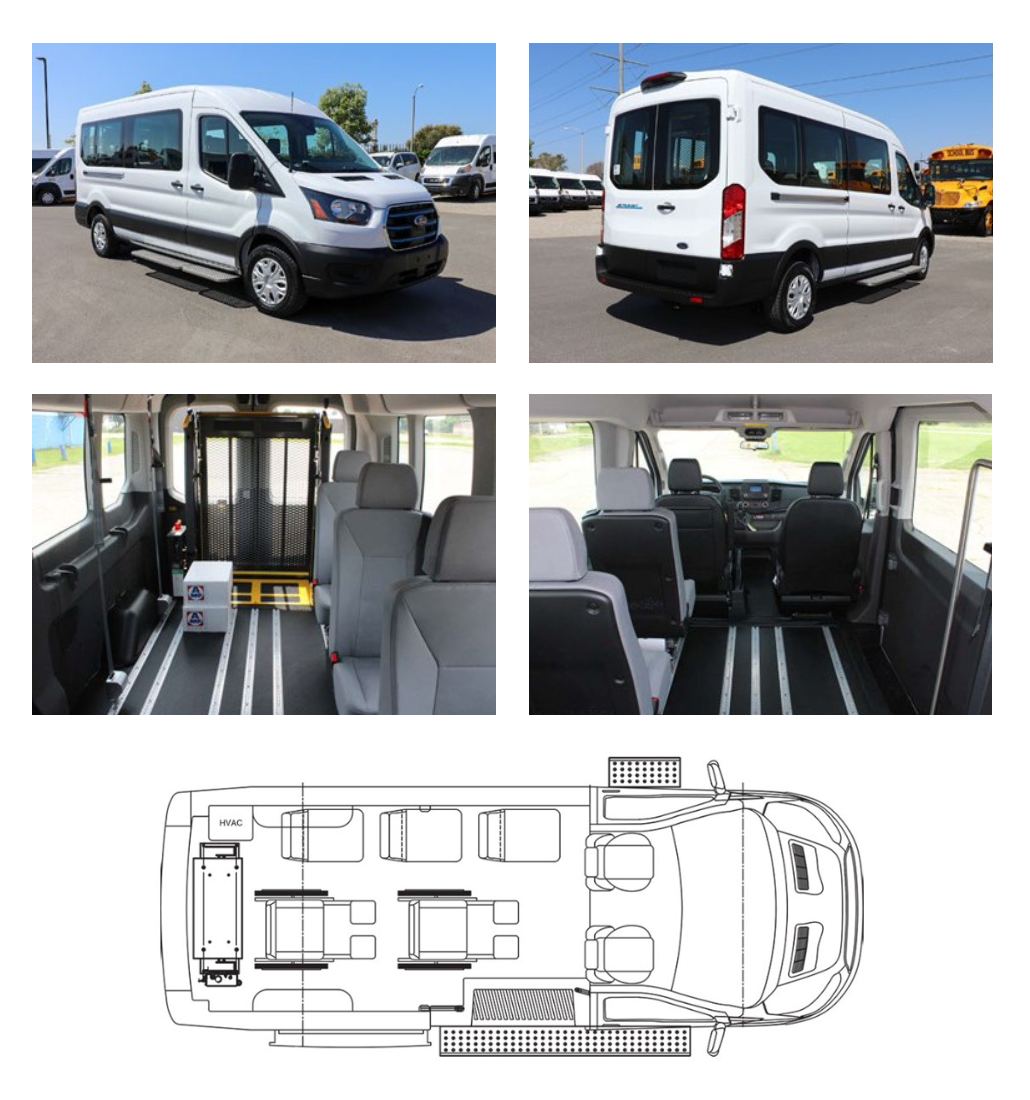
Ford E-Transit — Medium Roof (4+2)
Wheelchair-accessible: 4 ambulatory and 2 wheelchair positions, Braun lift. Images and floorplan.
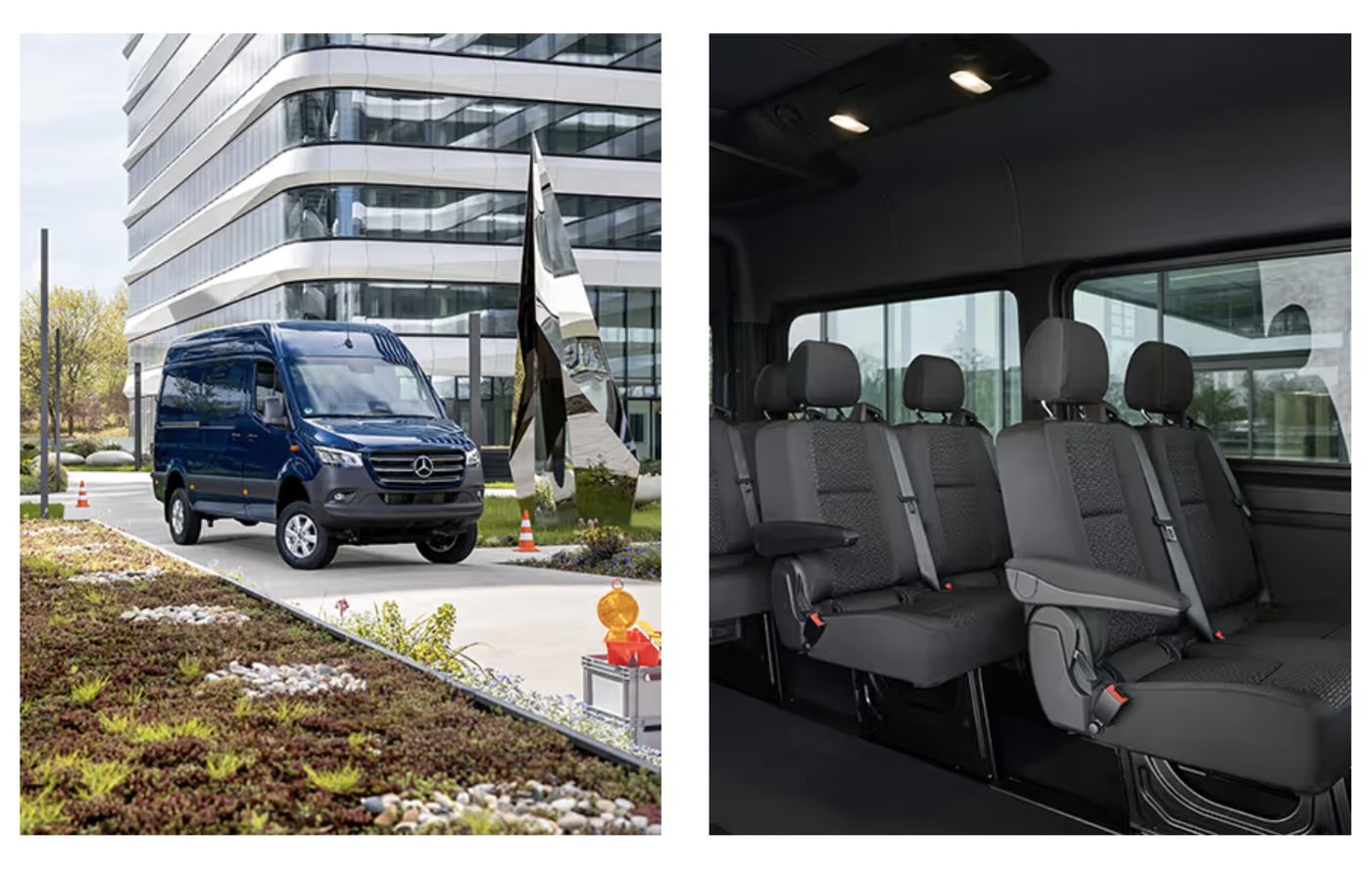
Mercedes eSprinter
12–14 passenger seat range.
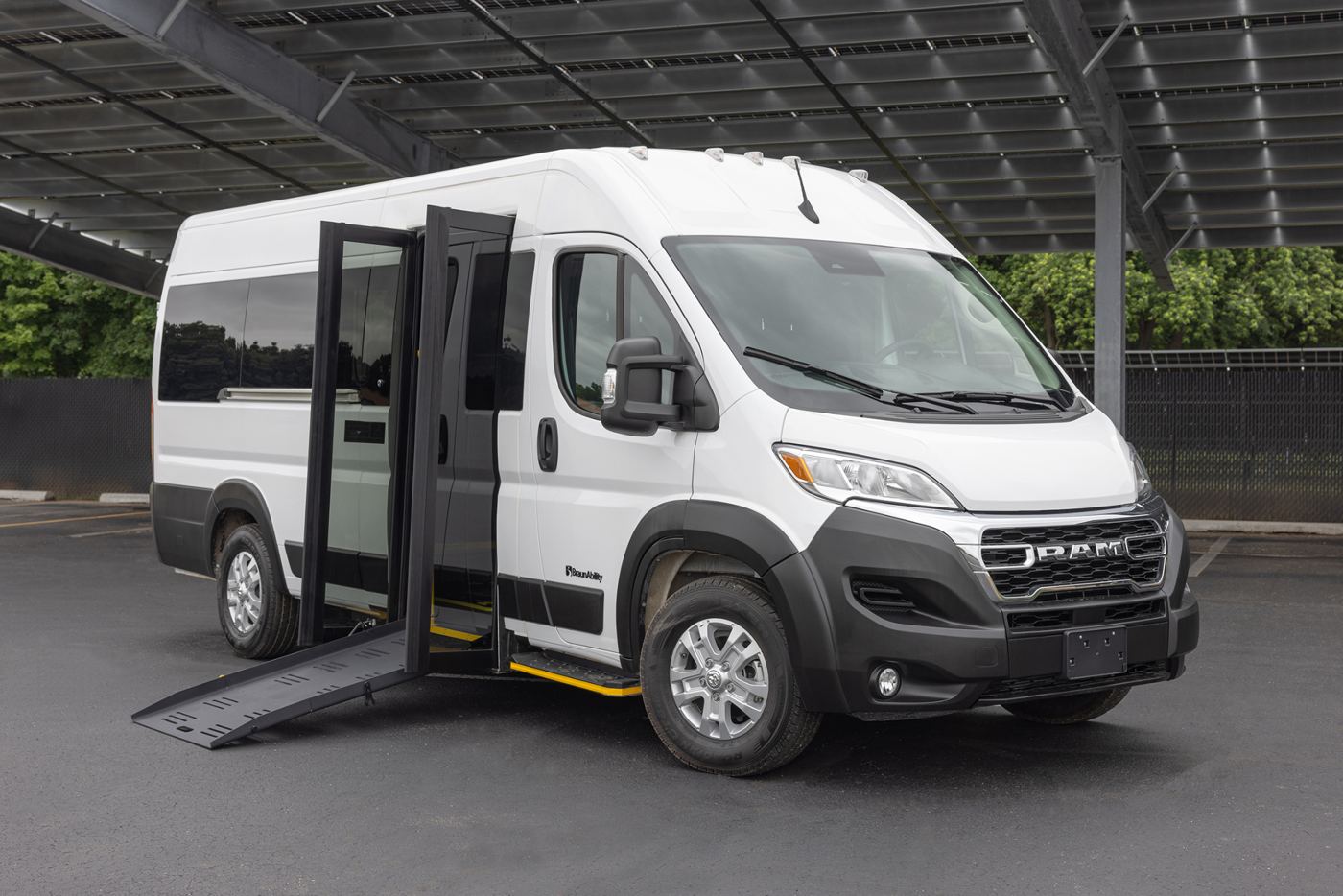
Ram ProMaster 3500 by BraunAbility
Wheelchair-accessible conversion.
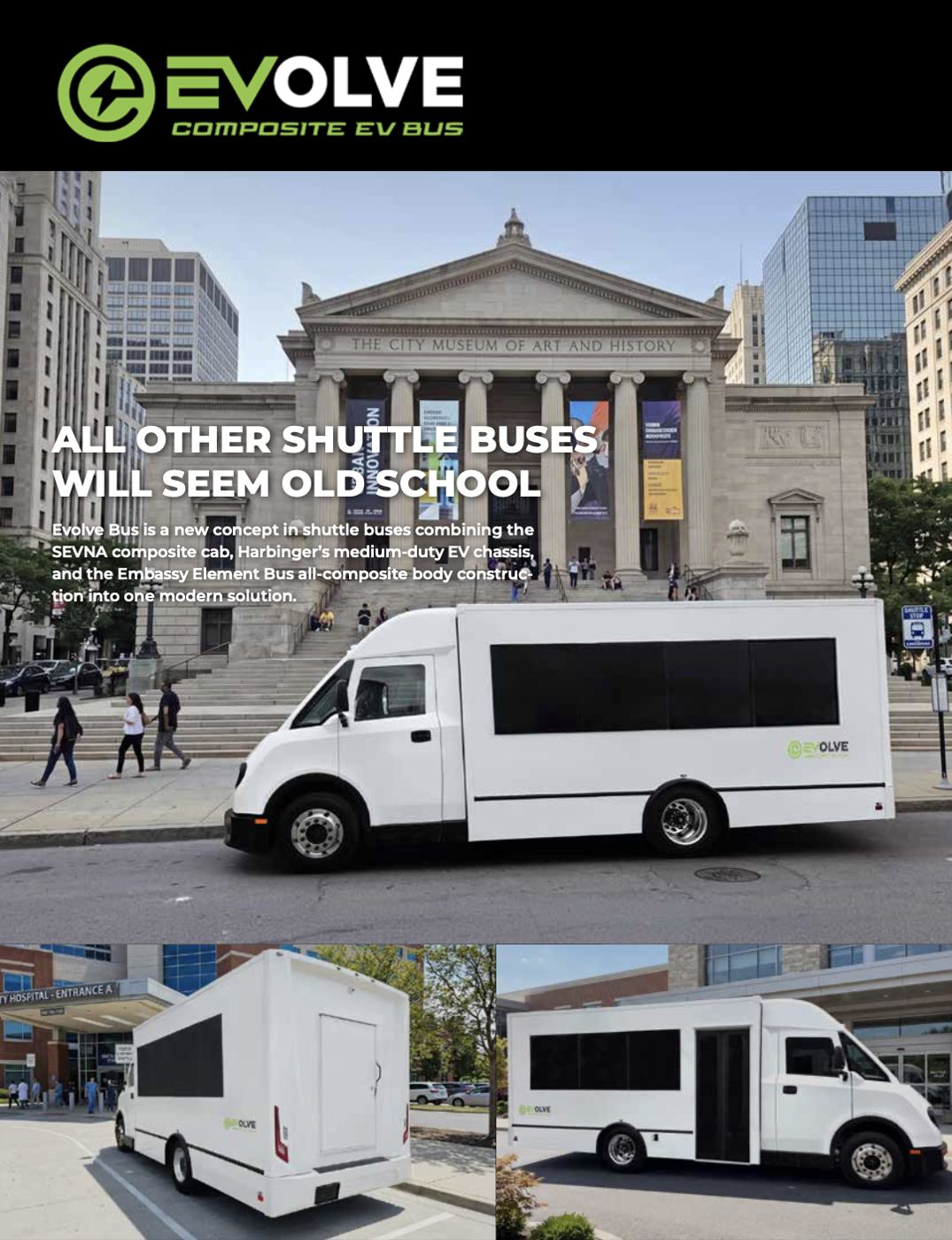
Class 5 shuttle bus on a Harbinger chassis
15–35 passenger range, 12 floor plans, 26′–33′ lengths.
View the spec sheet →Awardee commitments, and what happens after award
Summarized here so nothing is a surprise at contract stage. Established through the Participation Agreement and the lease Master Services Agreement. (RFA Section 3)
| Lease term | Typically a 60-month base term with monthly payments. Security deposit and any advance payment stated in the lease schedule. |
| Uptime | 97% in-service standard, measured quarterly. |
| Registration | Continuously registered and domiciled in New York State for the entire term. |
| Reporting | Monthly: VIN, make/model/year, garaged and charging address, registration and insurance expiry, service and uptime, maintenance, and whether the vehicle replaces a combustion unit. |
| Access | NYSERDA and its support contractors may access vehicles and sites to verify equipment. |
| Publicity | Dollaride and NYSERDA may photograph vehicles and sites for program reporting and communications. |
| Insurance | Commercial general liability and vehicle insurance at or above program minimums, naming CTAP LLC as additional insured and loss payee. |
- Conditional Allocation Letter issuedDollaride
- Fleet Operator Letter of Intent executedApplicant
- Outstanding documentation — authority certificates, insurance, revenue contracts, financialsApplicant
- Underwriting and credit reviewDollaride / lender
- Final deployment-readiness confirmationBoth
- Deployment Plan submitted to NYSERDADollaride
- NYSERDA Go/No-Go decision (up to 14 days)NYSERDA
- Participation Agreement and MSA executedBoth
- Vehicle order placedDollaride
- Delivery, registration, insurance, inspectionBoth
- Deployment and ongoing reportingAwardee
Apply for Round 3
The same Forms A, B and C as the PDF. Your answers save on this device as you go, so you can stop and come back. Due Friday, November 13, 2026, 5:00 PM ET.
Round 3 application
Forms A, B and C, in six steps. Answers save on this device as you go.
- 1Applicant
- 2Vehicles
- 3Schedule
- 4Drivers
- 5Operations
- 6Submit
Prefer paper-style? Download the fillable PDF and email it to RFA@dollaride.com. Rather talk first? Book a 30-minute meeting with us.
Get answers on the record
Send written questions to the designated contact by Wednesday, November 4, 5:00 PM ET. A consolidated Q&A goes to all registered applicants on Friday, November 6.
Register to receive addenda: email RFA@dollaride.com with your company name. Changes to the RFA are published only as numbered, dated addenda, sent to everyone registered.
Only the designated contact’s responses are binding on this solicitation. Responses from any other Dollaride representative are informal.
Answers to what operators ask first
Section references are to RFA-CTAP-2026-03.
I applied to Round 1 or Round 2. Do I need to apply again?
Round 1 (RFA-CTAP-2026-01) closed on August 31, 2026, and Round 2 (RFA-CTAP-2026-02) on October 23, 2026. If you applied to either, you’re on file and you don’t need to start over. Qualified applicants who didn’t receive an allocation are carried forward on the waitlist in submission order and don’t need to reapply. (Section 6.5)
If your fleet has changed since you applied, or you want to be considered for Round 3’s vehicles and terms, email RFA@dollaride.com and we’ll tell you what, if anything, to update.
Online or PDF — which should I use?
Whichever suits you. Both collect the same forms and are reviewed the same way. Online is faster and saves your answers on this device as you go. The PDF lets you work offline, share it internally before you submit, and send it when you’re ready. Either way, submit by Friday, November 13, 5:00 PM ET. (Section 5.4)
How do I fill in the PDF without printing it?
Open it in Adobe Acrobat Reader (free), Preview on a Mac, or Chrome or Edge. Click into any box to type, and click a checkbox to tick it. Then save the file — in a browser, use the download button so your answers are kept — and email it to RFA@dollaride.com with “RFA-CTAP-2026-03 — [Company Name]” in the subject line. No DocuSign or other software needed.
Is this a grant? Do I receive money?
No. CTAP is not a cash grant or a purchase subsidy paid to you. CTAP LLC purchases the vehicles, holds title, and leases them to awardees — the NYSERDA incentive is applied by Dollaride as lessor and shows up in the lease rate you pay. (Section 1.3)
What is the program worth to me in dollars?
On the lease. The RFA estimates a new CTAP electric lease at as low as $1,100 a month against roughly $1,600 for a comparable new gas van leased privately — about $500 a month per vehicle, with no down payment.
On fuel and parking, if you opt in. About $1,000 a month through CTAP against a typical NYC market cost of about $1,600 — roughly $600 a month per vehicle. Both components are optional.
These are the RFA’s estimates for comparison only; your actual costs depend on vehicle configuration, lease mileage, battery capacity, utilization, and which optional components you choose. (Section 2.1)
My drivers hold TLC licenses. Does that make my company eligible?
Not by itself — this is the most common reason a promising applicant turns out to be ineligible. Your company, as the operating entity, must hold operating authority in its own name: NYSDOT authority, a NYC TLC base or operating license, or other applicable authority. (Section 4.1)
We operate under a TLC for-hire base license. Can we run the Ford E-Transit?
Not yet, under that license alone. For wheelchair-accessible for-hire vehicles, the TLC only licenses models on its approved accessible vehicle list, and the Ford E-Transit isn’t on that list today. Until it’s added, the E-Transit goes into service under other operating authority — NYSDOT authority or a TLC commuter van authorization, or the wheelchair-accessible build under a TLC paratransit base.
If a TLC base license is the only authority your company holds, say so on Form C, along with the vehicle you’d actually want. Someone on our team can talk through the options.
What vehicles are available?
Ford E-Transit 350 configurations from 9 to 12 passengers, including wheelchair-accessible and stretcher-equipped builds; the Mercedes eSprinter (12–14 passengers); the Ram ProMaster 3500 wheelchair-accessible conversion by BraunAbility; and Class 5 shuttle buses on a Harbinger chassis (15–35 passengers). Other passenger EV models are also eligible. Vehicles must be battery-electric, with an acquisition cost between $52,501 and $232,500. (Sections 4.1, 7)
Do I need my own charging or parking?
No. Both are optional. Use the CTAP charging network and program parking in the Bronx, Brooklyn, and Queens on preferential terms, keep your own arrangements, or mix the two. The application asks you to identify a viable charging and parking pathway before vehicle handoff — yours or the program’s. (Sections 2.2, 4.3)
What do I submit? Do I need my financials ready?
Three self-reported forms — Form A (company profile), Form B (vehicle request and replacement schedule), Form C (operations checklist) — and no attachments. If a question doesn’t apply, write “N/A” rather than leaving it blank.
If you receive a Conditional Allocation, you’ll then be asked for operating authority certificates, proof of commercial auto liability insurance, executed revenue contracts, three years of financial statements or tax returns with a three-year cash-flow forecast, and evidence of driver licensing, training and background checks. (Sections 5.1–5.3)
How are applications evaluated, and how are vehicles allocated?
Two stages. First, a pass/fail eligibility screen — every applicant is told the outcome (eligible, deferred or denied) and the reason by November 20. Then eligible applications are scored: near-term replacement or expansion timing (35%), operational readiness (25%), potential vehicle volume (20%), and depth of service to disadvantaged communities (20%).
Applications received by the deadline that pass the screen are allocated in score order until Round 3’s vehicles are fully subscribed, subject to funding availability; ties go to the earlier submission. Qualified applicants not reached, and qualified applications received after the deadline, go on a waitlist in order of submission date, processed in that order if allocations expire or capacity is added. Waitlisted applicants don’t need to reapply for future rounds. (Cover page, Sections 6.1–6.5)
Can I keep working with my own dealer or lender?
Yes — that’s Track C. Your lender or dealer finances the vehicle through the program entity, which is what lets the incentive attach, and you lease under Track A or B. Indicate the relationship on Form B; Track C is confirmed case by case. (Sections 2.4–2.5)
Can I end up owning the vehicle?
Yes, under Track B, lease-to-own: a fixed-price purchase option at the end of the base lease term. The option can’t be exercised before the end of the NYSERDA Agreement term, and vehicles must stay registered and domiciled in New York State and meet the 97% in-service standard for the entire term. (Section 2.4)
What happens after I’m awarded?
You receive a Conditional Allocation Letter and a Fleet Operator Letter of Intent. From there: execute the LOI, produce the award-stage documentation, pass underwriting, and Dollaride submits a Deployment Plan to NYSERDA, which has up to 14 days to respond. Then the Participation Agreement and MSA are executed and the vehicle is ordered. The MSA deadline is tied to NYSERDA’s Go decision on the Deployment Plan (target as early as December 7); an allocation that isn’t converted to an executed agreement in time returns to the pool. Vehicles are deployed six to nine months from MSA execution. (Sections 3, 6.3–6.4)
What if I don’t meet every requirement today?
Apply anyway if the gap is fixable. “Deferred” covers requirements curable within the program period — insurance limits, for example. Dollaride states what needs to change and re-screens on request, without a new application. Only a non-waivable NYSERDA requirement results in a denial, and even then Dollaride will point to alternative programs where possible. (Section 4.4)
Is the information I submit confidential?
Application material is shared with NYSERDA and with the program’s lenders and financing partners for eligibility, reporting and credit review. Anything submitted to NYSERDA is subject to New York’s Freedom of Information Law unless it is a trade secret, plainly marked as confidential at the time you submit it. Labeling after submission doesn’t cure it.
- PDF: mark each page containing proprietary information “CONFIDENTIAL — TRADE SECRET” in the header or footer, and use the confidentiality designation box at the end of the forms.
- Online: use the confidentiality designation question in the last step.
- Either way, name the specific answers and briefly state why they’re a trade secret. Don’t designate the whole application — blanket designations are more likely to be challenged.
(Section 0.1)
These answers summarize RFA-CTAP-2026-03 for convenience and are not a substitute for it. On any difference, the RFA and its published addenda control.
Walk your lot, then apply.
Count what’s aging out, pick your route — online or PDF — and get your application in.